
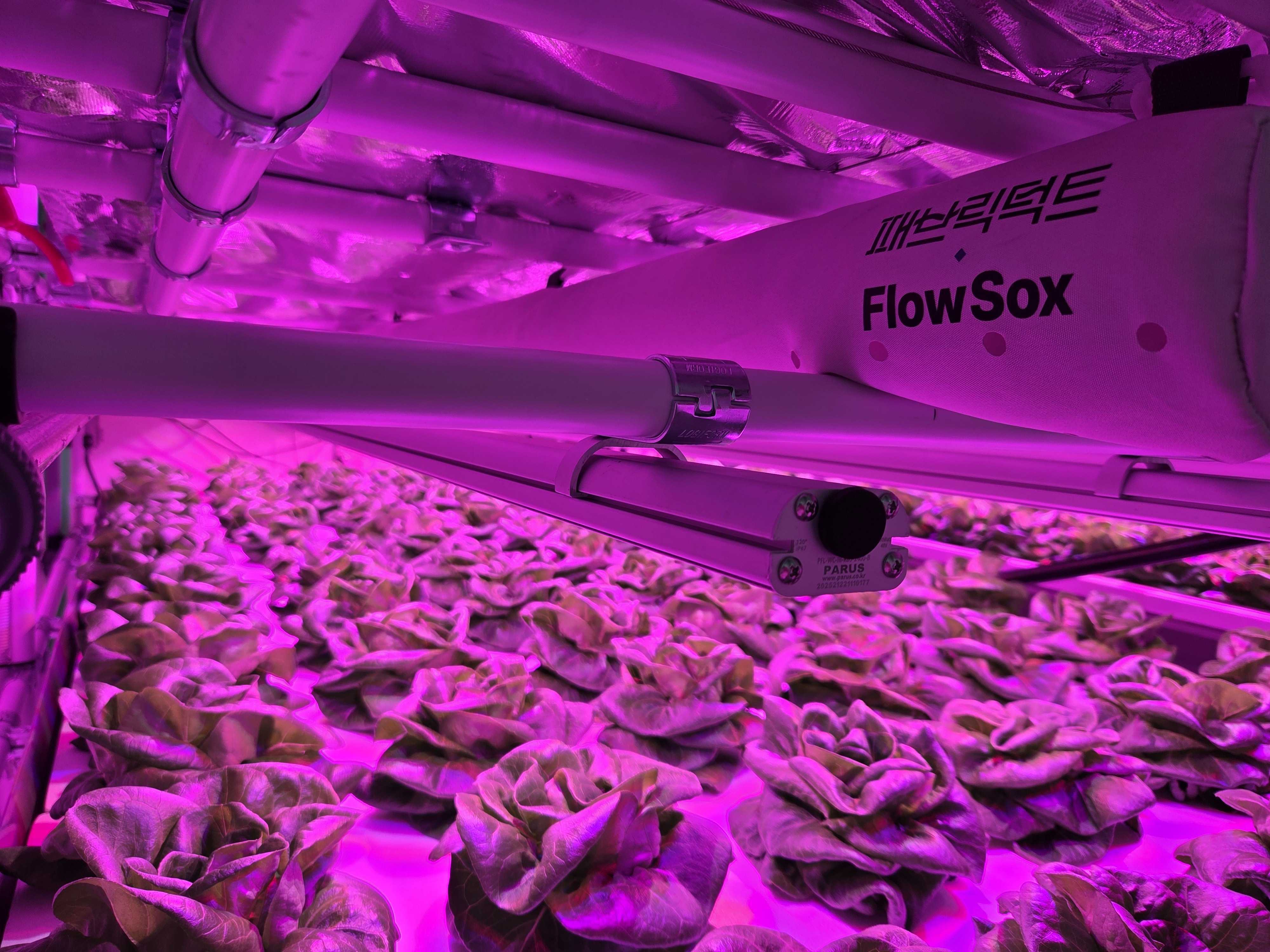
Whole-room airflow alone could not reach deep into multiple rows of crops. Heat and humid air remained around the leaves, creating location-dependent temperature, humidity and growth differences.
Consistent airflow supports transpiration and heat removal. Low velocity allowed air to stagnate above the crops, so achieving at least 0.5 m/s directly above the vegetables was a key requirement.
Persistent stagnation can contribute to damaged leaf tips. Poor airflow inside the racks prevented heat and moisture removal, making uniform crop-level airflow essential for stable growing conditions.
Placing ducts close to the crops delivered air deep inside the racks, rather than relying on whole-room supply, reducing stagnant zones above the leaves.
The target was at least 0.5 m/s at crop level. Gentle, uniform airflow passed over the plants instead of a strong one-directional draft, helping reduce temperature and humidity variation and tip-burn risks.
FlowSox displaced stagnant air above the crops, removing heat and moisture and reducing differences between racks and risks associated with insufficient airflow.
Airflow above 0.5 m/s directly over the vegetables enabled more precise growing-environment management than supplying air to the whole room.
Continuous removal of heat and moisture above the crops reduced differences between rack locations and stabilized the growing environment.
Consistent crop-level airflow helped address tip burn associated with stagnation, removing heat and moisture and supporting more uniform growth.
