
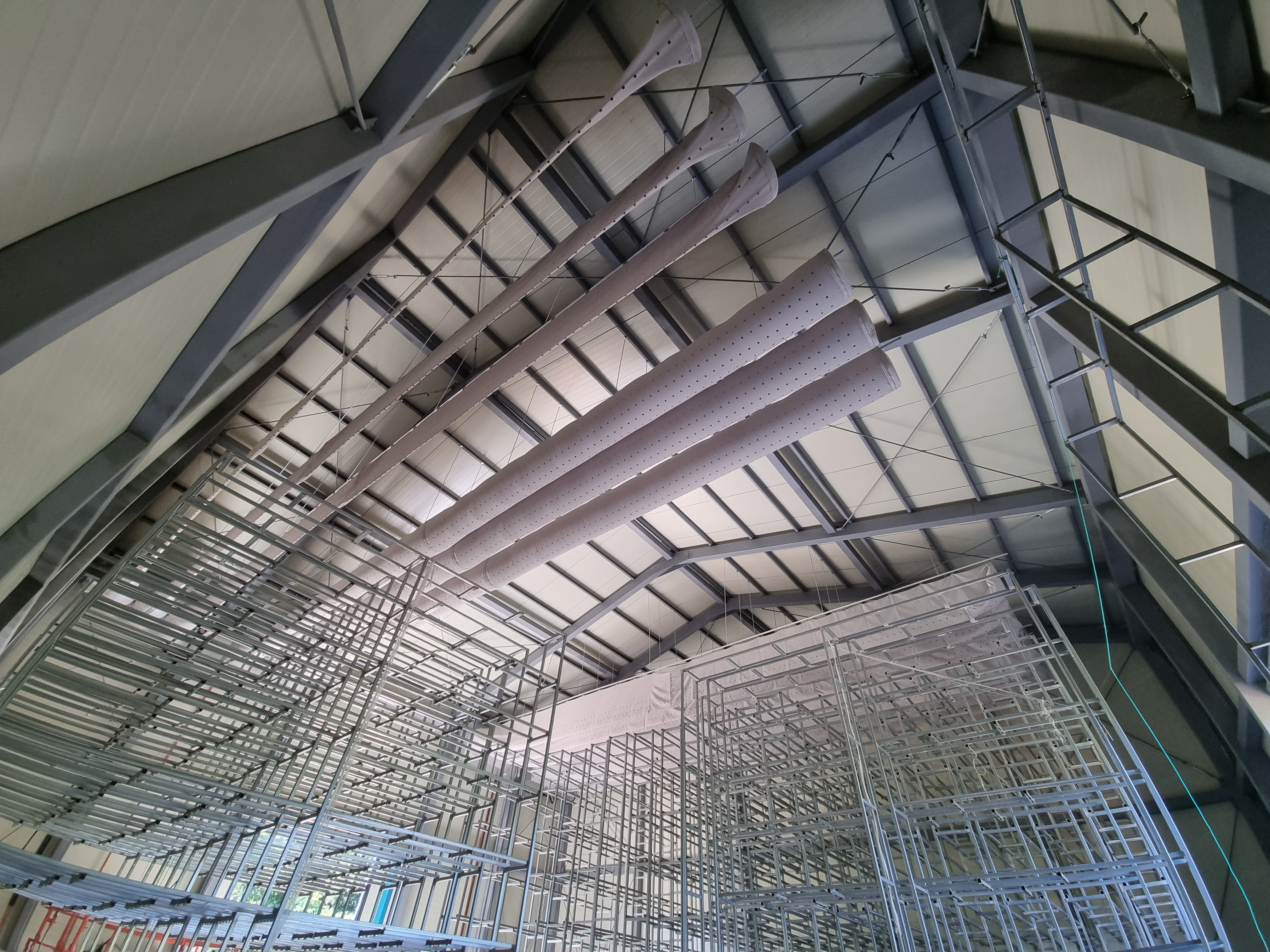
When outdoor temperatures drop sharply before dawn, maintaining strawberry-growing temperatures in the 9 m-high space requires substantial heating capacity and precise control.
Tall, densely stacked racks obstruct circulation, allowing upper tiers to overheat while lower tiers suffer cold damage and uneven growth.
Delivering the optimal 0.5 m/s airflow for photosynthesis and transpiration evenly through narrow rack spaces across nine tiers is extremely difficult with conventional duct design.
The precision control of air conditioners complemented the heat-exchange capacity of unit coolers. Coordinated operation during high-load winter dawn hours reduced energy use while maintaining the setpoint.
Directional perforations delivered 0.5 m/s airflow throughout the 8 m-high racks. Static pressure control maintained fresh-air delivery through to the farthest zones.
Circulation fans and fabric ducts moved warm ceiling air down to the lowest tier, minimizing temperature differences from the first to the ninth tier.
Hybrid heating maintained temperatures suited to strawberry growth even during the coldest hours, preventing cold-damage risks.
Airflow averaging 0.5 m/s reached throughout the foliage, supporting efficient crop growth.
Efficient load sharing between air conditioners and coolers reduced energy consumption compared with operating a single system and established precise, data-based HVAC control.
