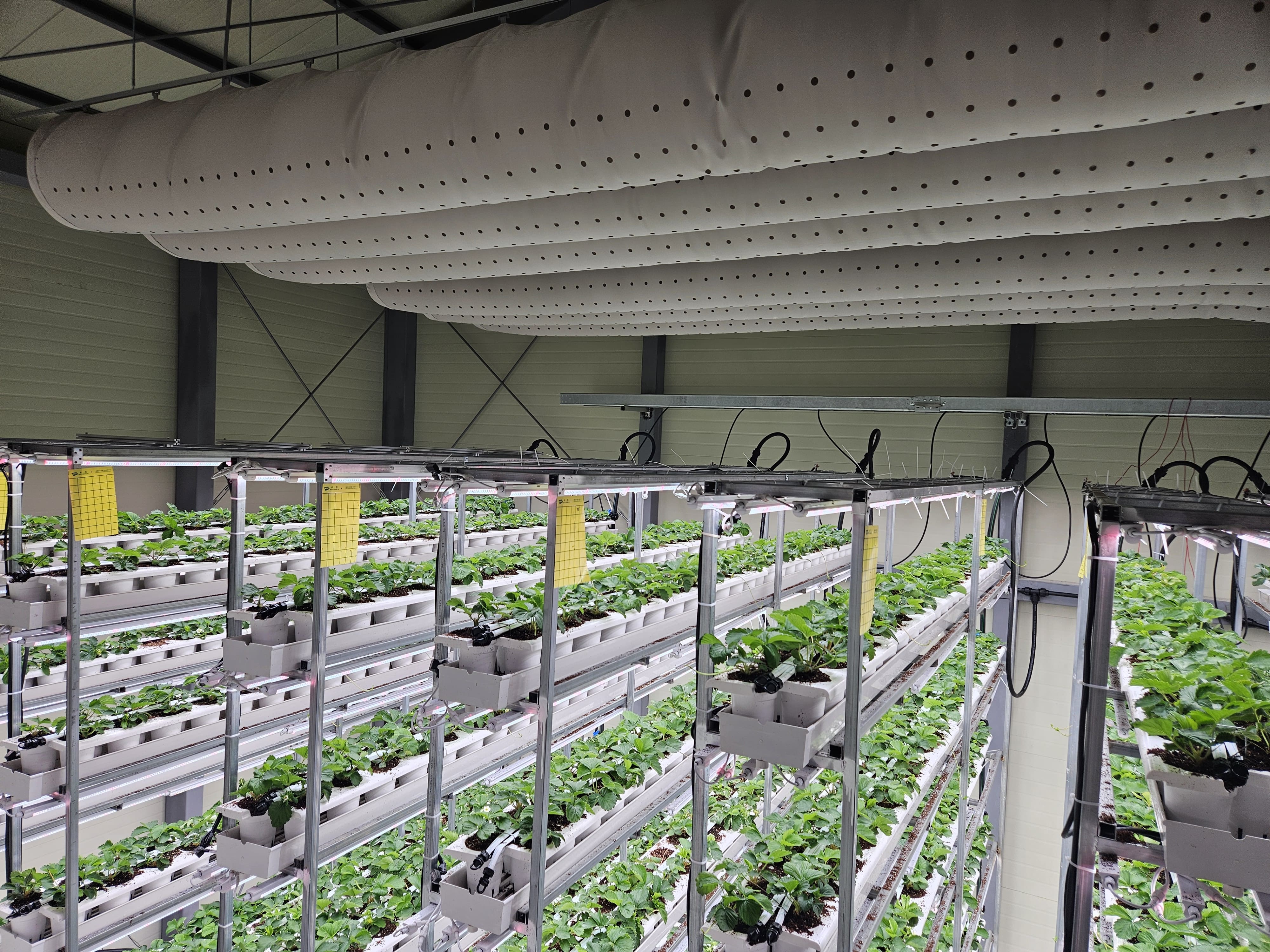
Warm air accumulated above the racks, producing significant differences in crop growth rates between the first and seventh tiers.
Seven tiers of growing shelves formed barriers to circulation. Humidity accumulated deep within the racks, increasing the risk of pests and disease.
Simply sending air downward from above could not maintain uniform temperature and humidity throughout the large vertical space.
Overhead fabric ducts were designed to deliver effective airflow to the lower cultivation tiers, reducing vertical temperature differences even in spaces over 7 m high.
Overhead fabric ducts directed airflow down to the lower cultivation tiers, helping reduce temperature differences throughout the high-ceiling growing space.
Air volume and discharge directions were adjusted for the seven crop tiers rather than the empty space, minimizing temperature and humidity differences between levels.
Despite the large 7 m vertical difference, temperature and humidity differences were stabilized at levels that did not affect growth, enabling uniform harvesting across the seven tiers.
Fresh air and CO₂ reached inside the complex seven-tier structure, improving crop vitality and significantly reducing the occurrence of pests and disease.
Auxiliary circulation devices working with fabric ducts improved HVAC operating efficiency and reduced the costs of running the large smart farm.
.jpg)