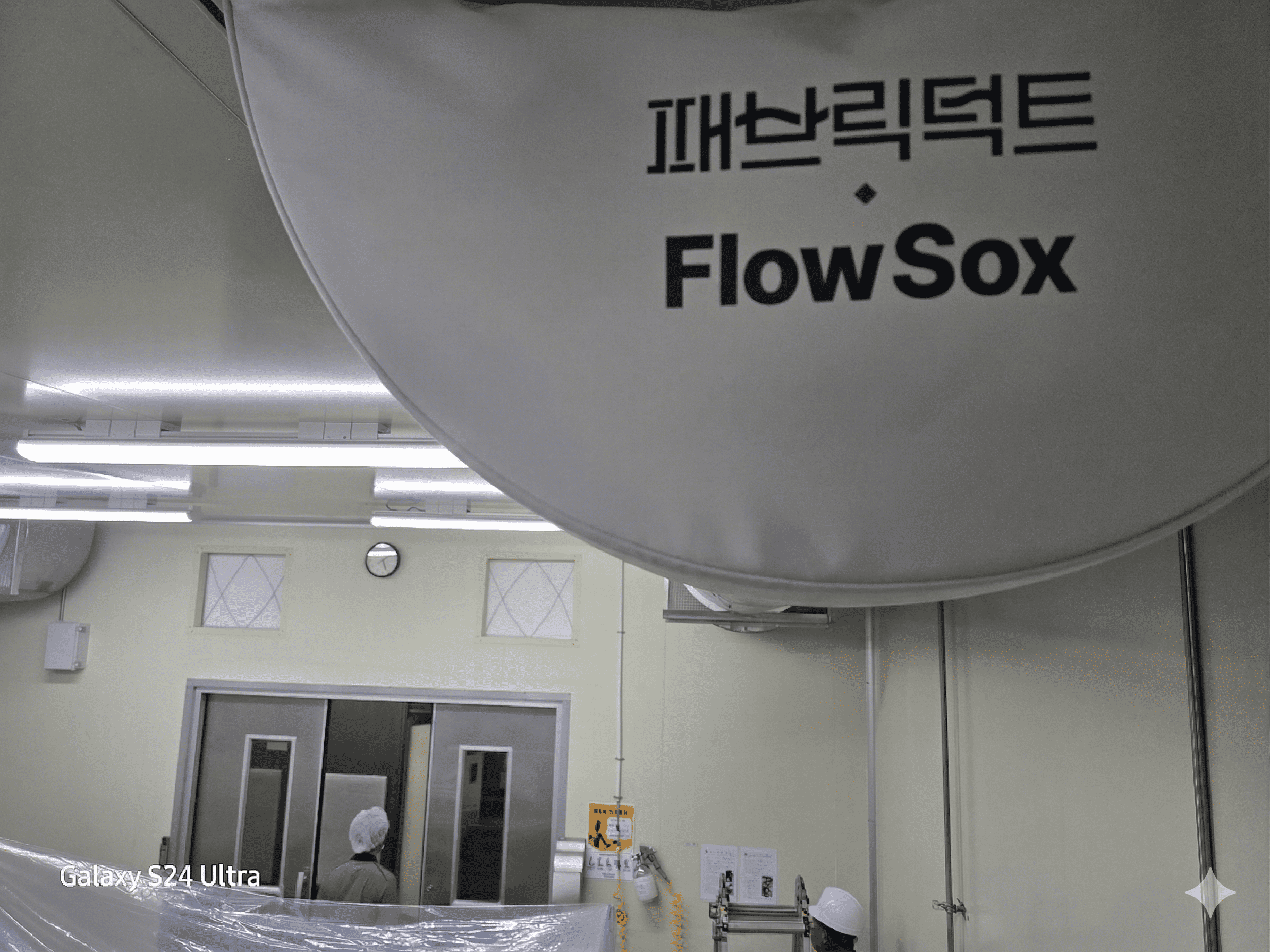
Although another fabric duct system was already installed, condensation persisted in wall corners and on machinery where air stagnated. Installation alone had not resolved the dew-point conditions.
Condensation on walls and equipment promoted mold and bacterial growth. Its presence near the packaging line posed a potential food-safety risk.
Increasing air speed to prevent condensation lifted fine floor dust toward packaging. Reducing velocity allowed condensation to return.
Instead of focusing only on central air supply, thin, broad streams of dry air were directed along vulnerable walls and machinery, keeping surfaces above the dew point.
Analysis of stagnant zones informed a new static-pressure design that circulated air throughout the room, including beneath machinery, resolving concealed condensation.
Distributed supply through small perforations provided the airflow needed for condensation control while suppressing dust. Custom hole layouts maintained dehumidification and stable floor-level velocity.
Condensation was resolved not only on ducts but also on wall finishes and manufacturing equipment, removing hygiene blind spots.
Removing the condensation environment reduced mold and bacterial risks and maintained a dry, comfortable processing environment.
Precision redesign resolved problems the previous system had not addressed, demonstrating the importance of specialist airflow engineering.
Precise velocity control combined HVAC and condensation control without lifting dust, improving packaging-line operating efficiency.